Saturday, April 20, 2019

Zeitschrift der Deutschen Morgenländischen Gesellschaft

http://menadoc.bibliothek.uni-halle.de/dmg/periodical/titleinfo/2327

Range of publication: 1847-2103
Die älteste und weltweit bekannteste Veröffentlichung der DMG ist ihre international zitierte Zeitschrift (ZDMG). Der 1. Band erschien 1847 als ein den gesamten deutschen Sprachraum umfassendes Organ der Orientalistik. Unterbrochen wurde das regelmäßige Erscheinen der Zeitschrift nur durch zeitbedingte Wechselfälle der deutschen Geschichte. Von Anfang an nutzten deutsche und ausländische Gelehrte die Zeitschrift, um Ergebnisse ihrer Forschungen darzulegen.

The Inscriptions of Israel/Palestine

The Inscriptions of Israel/Palestine

From the site:
The Inscriptions of Israel/Palestine project seeks to collect and make accessible over the Web all of the previously published inscriptions (and their English translations) of Israel/Palestine from the Persian period through the Islamic conquest (ca. 500 BCE - 640 CE). There are about 15,000 of these inscriptions, written primarily in Hebrew, Aramaic, Greek and Latin, by Jews, Christians, Greeks, and Romans. They range from imperial declarations on monumental architecture to notices of donations in synagogues to humble names scratched on ossuaries, and include everything in between.
As of March, 2016 there are approximately 2,500 inscriptions in the database, with more added regularly. All are encoded using the Epidoc guidelines. The inscriptions can be accessed via the "Search" Button on the left.
Inscriptions of Israel/Palestine is an ongoing project at Brown University. It has been generously supported by the Center of Digital Scholarship and the Goldhirsh-Yellin Foundation. We welcome your feedback.
About
Research
& Teaching

Related Sites
Bibliography
Search
Inscriptions

Tuesday, April 16, 2019

Index Theologicus: International Bibliography of Theology and Religious Studies

Index Theologicus: International Bibliography of Theology and Religious Studies

From the site:
The new IxTheo is a comprehensive bibliography for theology and religious studies. It is now possible to search not only for articles, but also for monographs, databases and relevant Internet links.
A selection of review journals is now also included. When the relevant licenses permit it, it is possible to access directly the complete text of the articles, reviews and books.

The new IxTheo remains a free and open access service to the worldwide scholarly community. The editors of the IxTheo are the Universitätsbibliothek Tübingen (library of the university of Tübingen) as well as the Evangelisch-Theologische Fakultät Tübingen (the protestant faculty of theology of the university of Tübingen) and the Katholisch-Theologische Fakultät Tübingen (the catholic faculty of theology of the same university).

We wish you an enjoyable experience as you explore the new IxTheo and we would be glad to get your feedback!

Sunday, November 25, 2018

Journal: Die Bibel in der Kunst (BiKu) / Bible in the Arts (BiA)

https://www.bibelwissenschaft.de/die-bibel-in-der-kunst/

From the homepage:

The journal presents articles on the reception history of the Bible in visual arts, literature and music. Short articles provide reviews of new books and reports on current research.

Herausgeberkreis / Editors

Editorial Board

  • Prof. Dr. Kai Bremer, Kiel (Deutsche Literatur)
  • Prof. Dr. Laura Copier, Utrecht (Film)
  • Dr. Siobhán Dowling-Long, Cork (Musicology)
  • Prof. Dr. Abdulla Galadari, Abu Dhabi (Islamic Studies)
  • Prof. Dr. Sabine Griese, Leipzig (Deutsche Literatur)
  • Prof. Dr. Heidi J. Hornik, Waco (Art History)
  • Prof. Dr. Gerhard Langer, Wien (Judaistik)
  • Prof. Dr. Klaus Niehr, Osnabrück (Kunstgeschichte)
  • Prof. Dr. Thomas Noll, Göttingen (Kunstgeschichte)
  • Prof. Dr. Thomas Schipperges, Tübingen (Musikwissenschaft)
Autorinnen und Autoren schreiben Ihre Beiträge bitte in diese Formatvorlage und schicken den Text als WORD-Datei sowie ggf. Abbildungen als jpg-Dateien an ein Mitglied des Herausgeberkreises (Richtlinien). Alle eingehenden Artikel werden einem peer-review-Verfahren unterzogen.
Authors are kindly asked to use this style sheet when submitting articles and to forward their manuscripts in the form of WORD files, images as separate JPG or PNG to one of the editors (guidelines). Every article received will be subject to a peer review process.

Jahrgang 2017

Sunday, September 30, 2018

The Digital Archaeological Atlas of the Holy Land

https://daahl.ucsd.edu/DAAHL/

From the site:

What is the Digital Archaeological Atlas of the Holy Land?

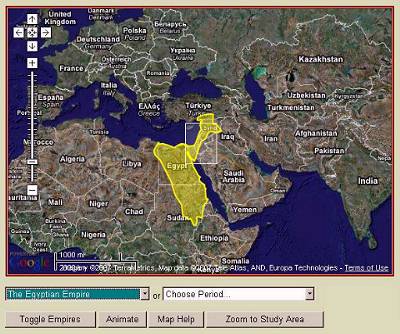
DAAHL's Google Maps interface for Empires
Click the "Empires" link above to open this page.
The Digital Archaeological Atlas of the Holy Land (DAAHL) is an international project that brings together experts in information technology including Geographic Information Systems (GIS) and the archaeology of the Holy Land (modern Israel, Palestine, Jordan, southern Lebanon, Syria and the Sinai Peninsula) to create the first on-line digital atlas of the region held sacred to the three great monotheistic faiths - Judaism, Christianity and Islam. Using the power of spatial information systems such as Google Maps and Google Earth, GIS, the tens of thousands of recorded archaeological sites for the region - from the remote prehistoric periods to the early 20th century - will be entered into a comprehensive database along with site maps, photographs and artifacts. The historical and archaeological content for this project will be developed by a team of over 30 international scholars working in the region, helping to provide the data used to create the Atlas. This website and its content will serve as the prototype "knowledge node" of a more comprehensive Digital Archaeological Atlas Network for the Mediterranean region.
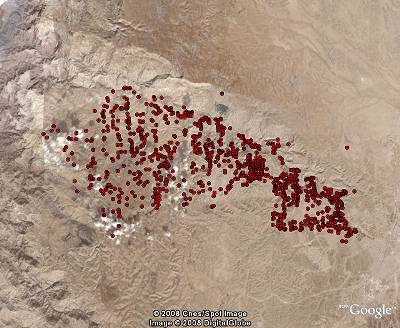
Archaeological sites in Wadi Hasa, Jordan,
plotted with DAAHL's database and Google Earth.
Click the "Search Database" link above to open this page.
New developments in telecommunications and information technology are revolutionizing the fields of archaeology, history, and the social sciences. The atlas represents a signature project of the Center for the Interdisciplinary Study of Art, Architecture and Archaeology (CISA3) at the University of California, San Diego and the Geo-Archaeological Information Applications (GAIA) Lab at Arizona State University. The atlas project brings together many of these advances based on new discoveries and the latest content concerning one of the most politically complex but meaningful geographic regions in world heritage. The control of time and space allow archaeologists to uncover address the 'big questions' of human history and social evolution. These include answering how and why the major technological revolutions of history occurred and influenced social and historical change in the Middle East. In broad strokes, the control of time and space are essential commodities in the construction of a heritage-based cyberinfrastructure, which come together for scholars and the general public in the DAAHL. New developments in GIS, high-precision radiometric dating methods, and archaeological fieldwork carried out in the Holy Land (Israel, Jordan, Palestine, Lebanon, southern Syria and the Sinai Peninsula) have helped identify significant "Global Moments" of fundamental social change in this region. The atlas will harvest, analyze and disseminate settlement pattern and new archaeological data for each key period of culture change in the Holy Land, from the Lower Paleolithic over 2 million years ago to the early 20th century when the region came under British control. 
 
This prototype web site is organized around two central themes, a series of case studies, historic maps, and database search functions. The "Empires" theme organizes information that illustrates the march of empires across the Middle East, from the development of the first Egyptian state in about 3000 BCE to the Ottoman Empire in 1918 CE. Here, the DAAHL concentrates on the impact of imperial "ordering templates" upon the lifeways of indigenous peoples in the region, as they are reflected and refracted by imperial and local traditions. The DAAHL website incorporates an interactive Google Maps interface, which can be animated to show the spatial footprints of more than 20 empires. A drop-down list lets the user select any of the empires; a selection automatically loads text in the right side of the page that introduces the empire, and queries the DAAHL database to present the archaeological sites in the database that were contemporary with the chosen empire. (The user must be zoomed in about halfway to see the site points). Each site point can be clicked to open a balloon with its name, and the name can be clicked to open a page in the atlas that contains three groups of information: 1) the listing from the DAAHL database, showing all the filled-in fields from the site table; 2) a listing of all the chapters or case studies in the DAAHL website that discuss the project; 3) a detailed, verbal description of the site, which can be richly embedded with pictures, tables, and static maps.

Wednesday, September 12, 2018

JANES - Journal of the Ancient Near Eastern Society

https://janes.scholasticahq.com/

Issues currently available:

2011 (1)
2009 (1)
2006 (1)
2002 (1)
2001 (1)
2000 (1)
1998 (1)
1997 (1)
1996 (1)
1995 (1)
1993 (1)
1992 (1)
1991 (1)
1989 (1)
1986 (1)
1984 (1)
1983 (1)
1982 (1)
1981 (1)
1980 (1)
1979 (1)
1978 (1)
1977 (1)
1976 (1)
1975 (1)
1974 (1)
1973 (1)
1972 (2)
1971 (1)
1970 (2)
1969 (2)
1968 (1)