Sunday, March 27, 2022

Hebrew Transliteration

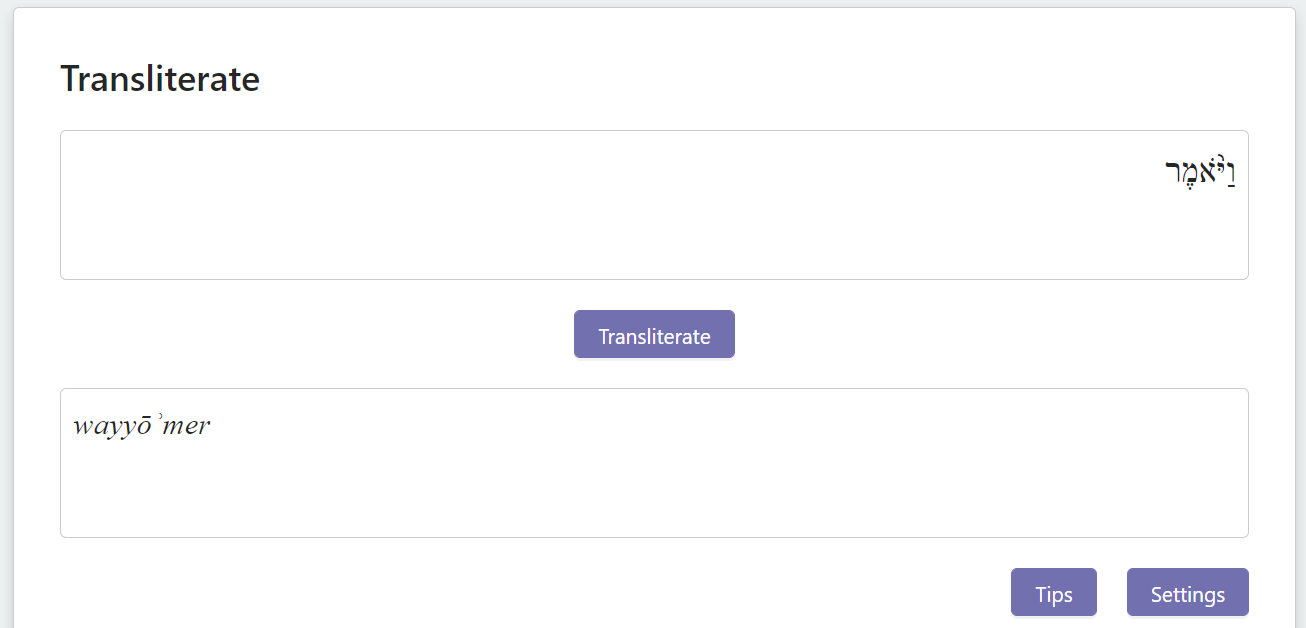
 Charles Loder has created an app that transliterates Hebrew. When you open it, it looks like this:


As you can see, the example does a pretty good job, except that it does not distinguish plosives from fricatives (e.g., the "b" and "t" are not underlined.) There are three schema to choose from and there are some other ways to customize it.

You copy/paste Hebrew into the top box, and presto! It translates the word. I tried copy/pasting the following from Logos:


ANE Site Placemarks for Google Earth


According to the website download Google Earth and open it. Then open the ANE Site Placements from within Google Earth. Unfortunately, it's not clear to me how to do that.

Further from the website:

ANE.kmz is a set of site placemarks for Google Earth of a selection of the most important archaeological sites in the Ancient Near East. ANE.kmz works with Google Earth Pro, which first has to be downloaded for free. When opened inside Google Earth Pro, ANE.kmz gives, to the left, an alphabetic list of ancient sites and, to the right, on the satellite images the same sites marked. For the moment, there are some 2500 sites with modern names; among them some 400 have ancient names. Additions of more sites are planned. Ancient names are written without parenthesis. Modern names are within parenthesis. Most sites have been identified on the satellite images.

ANE Waters.kmz is an experimental set of provisional water placemarks for Google Earth covering Mesopotamia up to modern time.

ANE Picture.jpg is just illustrating the appearence of ANE.kmz before zooming in and is not for use.

Saturday, March 19, 2022

A Collection of Ancient Inscriptions from Israel/Palestine

 Collection of Ancient Inscription from Israel/Palestine

From the website:

The Inscriptions of Israel/Palestine project seeks to collect and make freely accessible all of the previously published inscriptions (and their English translations) of Israel/Palestine from the Persian period through the Islamic conquest (ca. 500 BCE - 640 CE). Epigraphy is the study of such inscriptions, defined as texts written on durable materials (except for coins, which falls under the academic category of numismatics). There are about 10,000 of these inscriptions, written primarily in Hebrew, Aramaic, Greek and Latin, by Jews, Christians, Greeks, and Romans. They range from imperial declarations on monumental architecture to notices of donations in synagogues to humble names scratched on ossuaries, and include everything in between.

These inscriptions are an invaluable resource for historical investigation, for they provide information that is frequently not available in the extant literary texts. Recently, for example, scholars have used these inscriptions to:

  • Reconstruct the ancient Roman road system throughout Israel/Palestine, thus revising our understanding of trade routes and the economy;
  • Investigate the involvement of the Roman government in municipal building projects;
  • Revise our understanding of the Bar-Kokhba Revolt, suggesting that the revolt was far more serious than we previously thought;
  • Recover the role (and perhaps even voices) of women in Jewish and Christian communities - voices that otherwise are silent in the literary record; -Provide insight into linguistic use and change in the area.

Some examples of the kind of information that inscriptions provide about the ancient world can be found on our "Stories" page. Please take a look and tell us what you think!

All inscriptions are encoded according to Epidoc guidelines.

The DOI of the project is: 10.26300/pz1d-st89 (https://doi.org/10.26300/pz1d-st89)

Wednesday, March 2, 2022

Tyndale Bulletin

 Tyndale Bulletin

A source for solid, evangelical/creedal scholarship.

Monday, February 28, 2022

Bible & Archaeology

 Bible & Archaeology

From the website:

Bible & Archaeology was founded in 2021 at the University of Iowa by professor Robert R. Cargill and former University President Bruce Harreld. It is a not-for-profit 501(c)3 nonsectarian, nondenominational, educational organization promoting biblical studies, archaeology, and the intersection of the two disciplines in the Mediterranean and Southwest Asia—the areas traditionally called the “lands of the Bible.”

Bible & Archaeology is a popular online website and resource offering visitors an array of news, information, tools, and resources related to the study of the Bible and archaeology. These include original articles written by the very scholars making the discoveries, breaking news stories, articles, videos, and online courses taught by the world’s best scholars, study tours, lexicons, maps, puzzles, games, and trivia.

Sample articles:
The Tel Dan Inscription

The Name "Palestine" (and Why Scholars Use It)

Tuesday, October 19, 2021


Welcome to International Voices in Biblical Studies (Online ISSN 1949-8411), an online, peer reviewed, open-access book series that provides a platform for biblical critics and authors particularly from Africa, Asia, Latin America, the Caribbean, the Pacific, and Eastern Europe.The series will publish scholarly, creative, and compelling works that engage the biblical text, its history, reception, and interpretation. Works could be traditional or experimental in method and perspective, but with serious attention to context, be it local, regional or global. Submissions in local vernaculars will also be considered. Whenever possible, the works will be published in English and the primary language of the author.


The SBL Press IVBS editorial board is led by series editor Jione Havea (Independent Scholar) and includes the following members:

 
IVBS Editorial Board 
Jin Young Choi, Colgate Rochester Crozer Divinity School
Emily Colgan, Trinity Theological College
Musa Dube, University of Botswana
Julián Andrés González, Pacific Lutheran Theological Seminary
David Joy, Union Theological College (Bangalore)
Gerald O. West, University of KwaZulu-Natal
 
Welcoming the Nations: International Sociorhetorical Explorations
Edited by Vernon K. Robbins and Roy R. Jeal, 2020
DownloadPaperbackHardcover
Reading Ecclesiastes from Asia and Pasifika
Edited by Jione Havea and Peter H. W. Lau, 2020
DownloadPaperbackHardcover
Stories of Minjung Theology: The Theological Journey of Ahn Byung-Mu in His Own Words
Ahn Byung-Mu; Translated by In Hanna and Park Wongi , 2019
DownloadPaperbackHardcover
Landscapes of Korean and Korean American Biblical Interpretation
Edited by John Ahn, 2019
DownloadPaperbackHardcover
A Filipino Resistance Reading of Joshua 1:1–9
By Lily Fetalsana-Apura, 2019
DownloadPaperbackHardcover
A Samoan Reading of Discipleship in Matthew
By Vaitusi Nofoaiga, 2017
DownloadPaperbackHardcover
Reading Ruth in Asia
edited by Jione Havea and Peter H. W. Lau, 2015
DownloadPaperbackHardcover
Migration and Diaspora: Exegetical Voices of Women
in Northeast Asian Countries
Hisako Kinukawa, 2014
DownloadPaperbackHardcover
Zer Rimonim: Studies in Biblical Literature and Jewish Exegesis
Michael Avioz, 2013
DownloadPaperbackHardcover
Women at Work in the Deuteronomistic History
Mercedes L. García Bachmann, 2013
DownloadPaperbackHardcover
The Old Testament and Christian Spirituality: Theoretical and Practical Essays from a South African Perspective
Christo Lombaard, 2012
DownloadPaperback
Reading Ezra 9–10 Tu’a-Wise: Rethinking Biblical Interpretation in Oceania
Nasili Vaka’uta, 2011 
DownloadPaperback
Global Hermeneutics? Reflections and Consequences
Knut Holter and Louis Jonker, 2010 
DownloadPaperback