Friday, April 15, 2022

Open Access Monograph Series: ANCIENT NEAR EAST MONOGRAPHS

 SBL's ANE Monographs series has released the following volumes:

The Development of Biblical Hebrew Prepositions
By H. H. Hardy II ANEM 28, 2022
downloadpaperbackhardcover
“Wordplay” in Ancient Near Eastern Texts
By Scott B. Noegel ANEM 26, 2021
downloadpaperbackhardcover
Sounding Sensory Profiles in the Ancient Near East
Edited by Annette Schellenberg and Thomas Krüger ANEM 25, 2019
downloadpaperbackhardcover
A House of Weeping: The Motif of Tears in Akkadian and Hebrew Prayers
By David A. Bosworth, ANEM 24, 2019
downloadpaperbackhardcover
Archaeology and History of Eighth-Century Judah
Edited by Zev I. Farber and Jacob L. Wright, ANEM 23, 2018
downloadpaperbackhardcover
Invention of the First-Century Synagogue
By Lidia D. Matassa, edited by Jason M. Silverman, and J. Murray Watson, ANEM 22, 2018
downloadpaperbackhardcover
Perchance to Dream: Dream Divination in the Bible and the Ancient Near East
Edited by Esther J. Hamori and Jonathan Stökl, ANEM 21, 2018
downloadpaperbackhardcover
Infancia y legalidad en el Próximo Oriente antiguo durante el Bronce Reciente (ca. 1500–1100 a. C.)
Daniel Justel, ANEM 20, 2018
downloadpaperbackhardcover
Reflections of Empire in Isaiah 1–39: Responses to Assyrian Ideology
By Shawn Zelig Aster, ANEM 19, 2017
downloadpaperbackhardcover
Household and Family Religion in Persian-Period Judah: An Archaeological Approach
By José E. Balcells Gallarreta, ANEM 18, 2017
downloadpaperbackhardcover
Exploring Zechariah, Volume 2: The Development and Role of Biblical Traditions in Zechariah
By Mark J. Boda, ANEM 17, 2017
downloadpaperbackhardcover
Exploring Zechariah, Volume 1: The Development of Zechariah and Its Role within the Twelve
By Mark J. Boda, ANEM 16, 2017
downloadpaperbackhardcover
Mapping Judah’s Fate in Ezekiel’s Oracles against the Nations
By Lydia Lee, ANEM 15, 2016
downloadpaperbackhardcover
Priests and Cults in the Book of the Twelve
Edited by Lena-Sofia Tiemeyer, ANEM 14, 2016
downloadpaperbackhardcover
Political Memory in and after the Persian Empire
edited by Jason M. Silverman and Caroline Waerzeggers, ANEM 13, 2015
downloadpaperbackhardcover
Epigraphy, Philology, and the Hebrew Bible: Methodological Perspectives on Philological and Comparative Study of the Hebrew Bible in Honor of Jo Ann Hackett
edited by Jeremy M. Hutton and Aaron D. Rubin, ANEM 12, 2015
downloadpaperbackhardcover
Disembodied Souls: The Nefesh in Israel and Kindred Spirits in the Ancient Near East, with an Appendix on the Katumuwa Inscription
by Richard C. Steiner, ANEM 11, 2015
download
paperbackhardcover
The Book of the Twelve and the New Form Criticism
edited by Mark J. Boda, Michael H. Floyd, and Colin M. Toffelmire, ANEM 10, 2015
downloadpaperbackhardcover
Historical Linguistics and Biblical Hebrew: Steps Toward an Integrated Approach  
by Robert Rezetko and Ian Young, ANEM 9, 2014
download
paperbackhardcover
Israel and the Assyrians: Deuteronomy, the Succession Treaty of Esarhaddon, and the Nature of Subversion  
by C. L. Crouch, ANEM 8, 2014
download
paperbackhardcover
Divination, Politics, and Ancient Near Eastern Empires
edited by Alan Lenzi and Jonathan Stökl, ANEM 7, 2014
download
paperbackhardcover
Deuteronomy-Kings as Emerging Authoritative Books: A Conversation  
edited by Diana V. Edelman, ANEM 6, 2014
download
paperbackhardcover
The Forgotten Kingdom: The Archaeology and History of Northern Israel 
by Israel Finkelstein, ANEM 5, 2013
download
paperbackhardcover
Constructs of Prophecy in the Former and Latter Prophets and Other Texts 
edited by Lester L. Grabbe and Martti Nissinen, ANEM 4, 2011
download
paperback
Reading Akkadian Prayers and Hymns: An Introduction 
Alan Lenzi, ANEM 3, 2011
download

corrigenda
paperback
El Intercambio de Bienes entre Egipto y Asia Anterior: Desde el reinado de Tuthmosis III hasta el de Akhenaton 
Graciela Gestoso Singer, ANEM 2, 2008
download
Centro y periferia en el mundo antiguo: El Negev y sus interacciones con Egipto, Asiria, y el Levante en la Edad del Hierro (1200-586 a.C.)
Juan Manuel Tebes, ANEM 1, 2008
 download

Sunday, March 27, 2022

Hebrew Transliteration

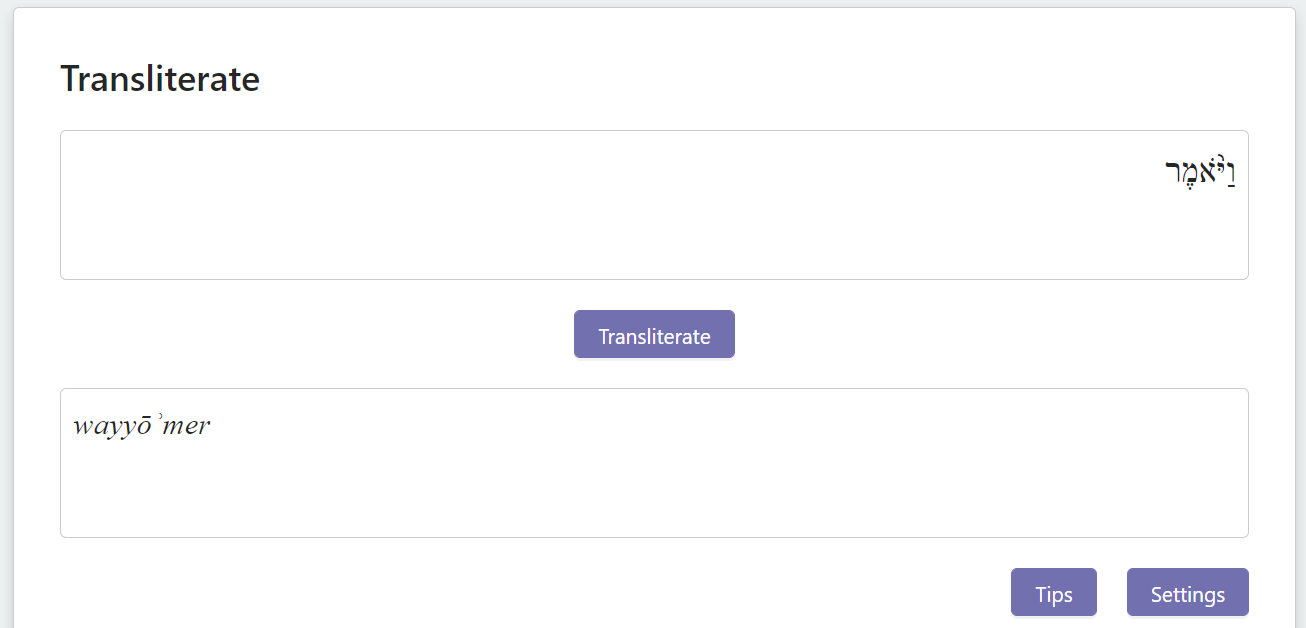
 Charles Loder has created an app that transliterates Hebrew. When you open it, it looks like this:


As you can see, the example does a pretty good job, except that it does not distinguish plosives from fricatives (e.g., the "b" and "t" are not underlined.) There are three schema to choose from and there are some other ways to customize it.

You copy/paste Hebrew into the top box, and presto! It translates the word. I tried copy/pasting the following from Logos:


ANE Site Placemarks for Google Earth


According to the website download Google Earth and open it. Then open the ANE Site Placements from within Google Earth. Unfortunately, it's not clear to me how to do that.

Further from the website:

ANE.kmz is a set of site placemarks for Google Earth of a selection of the most important archaeological sites in the Ancient Near East. ANE.kmz works with Google Earth Pro, which first has to be downloaded for free. When opened inside Google Earth Pro, ANE.kmz gives, to the left, an alphabetic list of ancient sites and, to the right, on the satellite images the same sites marked. For the moment, there are some 2500 sites with modern names; among them some 400 have ancient names. Additions of more sites are planned. Ancient names are written without parenthesis. Modern names are within parenthesis. Most sites have been identified on the satellite images.

ANE Waters.kmz is an experimental set of provisional water placemarks for Google Earth covering Mesopotamia up to modern time.

ANE Picture.jpg is just illustrating the appearence of ANE.kmz before zooming in and is not for use.

Saturday, March 19, 2022

A Collection of Ancient Inscriptions from Israel/Palestine

 Collection of Ancient Inscription from Israel/Palestine

From the website:

The Inscriptions of Israel/Palestine project seeks to collect and make freely accessible all of the previously published inscriptions (and their English translations) of Israel/Palestine from the Persian period through the Islamic conquest (ca. 500 BCE - 640 CE). Epigraphy is the study of such inscriptions, defined as texts written on durable materials (except for coins, which falls under the academic category of numismatics). There are about 10,000 of these inscriptions, written primarily in Hebrew, Aramaic, Greek and Latin, by Jews, Christians, Greeks, and Romans. They range from imperial declarations on monumental architecture to notices of donations in synagogues to humble names scratched on ossuaries, and include everything in between.

These inscriptions are an invaluable resource for historical investigation, for they provide information that is frequently not available in the extant literary texts. Recently, for example, scholars have used these inscriptions to:

  • Reconstruct the ancient Roman road system throughout Israel/Palestine, thus revising our understanding of trade routes and the economy;
  • Investigate the involvement of the Roman government in municipal building projects;
  • Revise our understanding of the Bar-Kokhba Revolt, suggesting that the revolt was far more serious than we previously thought;
  • Recover the role (and perhaps even voices) of women in Jewish and Christian communities - voices that otherwise are silent in the literary record; -Provide insight into linguistic use and change in the area.

Some examples of the kind of information that inscriptions provide about the ancient world can be found on our "Stories" page. Please take a look and tell us what you think!

All inscriptions are encoded according to Epidoc guidelines.

The DOI of the project is: 10.26300/pz1d-st89 (https://doi.org/10.26300/pz1d-st89)

Wednesday, March 2, 2022

Tyndale Bulletin

 Tyndale Bulletin

A source for solid, evangelical/creedal scholarship.

Monday, February 28, 2022

Bible & Archaeology

 Bible & Archaeology

From the website:

Bible & Archaeology was founded in 2021 at the University of Iowa by professor Robert R. Cargill and former University President Bruce Harreld. It is a not-for-profit 501(c)3 nonsectarian, nondenominational, educational organization promoting biblical studies, archaeology, and the intersection of the two disciplines in the Mediterranean and Southwest Asia—the areas traditionally called the “lands of the Bible.”

Bible & Archaeology is a popular online website and resource offering visitors an array of news, information, tools, and resources related to the study of the Bible and archaeology. These include original articles written by the very scholars making the discoveries, breaking news stories, articles, videos, and online courses taught by the world’s best scholars, study tours, lexicons, maps, puzzles, games, and trivia.

Sample articles:
The Tel Dan Inscription

The Name "Palestine" (and Why Scholars Use It)