Wolfram von Soden's Akkadisches Handwöterbuch (1965-1974), in a three-volume PDF. (The volumes are in German.)
Thursday, April 30, 2015


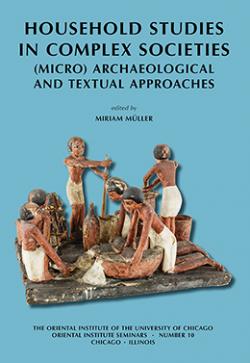
New Book from the OI: Household Studies in Complex Societies
Some of the essays in this volume from the OI may bear on the maximalist/minimalist debate.
OIS 10. Household Studies in Complex Societies: (Micro) Archaeological and Textual Approaches
|
Thursday, April 9, 2015
Access JSTOR via MyJSTOR
https://www.jstor.org/action/registration
JSTOR is a huge aggregator of literature, including that which is related to Biblical Studies. Typically, one accesses it through one's institution. Without an institutional affiliation, however, there are paid and free means of accessing the database. The above link takes you to the free method: the "MyJSTOR" account. It allows read-only access to a maximum of 3 articles for two weeks. There is a bookshelf for "holding" articles during the two-week period.
JSTOR is a huge aggregator of literature, including that which is related to Biblical Studies. Typically, one accesses it through one's institution. Without an institutional affiliation, however, there are paid and free means of accessing the database. The above link takes you to the free method: the "MyJSTOR" account. It allows read-only access to a maximum of 3 articles for two weeks. There is a bookshelf for "holding" articles during the two-week period.
Saturday, April 4, 2015
40 Maps That Explain the Middle East
http://www.vox.com/a/maps-explain-the-middle-east
This one overlaps only briefly with the focus of this blog, but I'm posting it because it is helpful in looking at the historical and contemporary relevance of the Middle East.
This one overlaps only briefly with the focus of this blog, but I'm posting it because it is helpful in looking at the historical and contemporary relevance of the Middle East.
Monday, March 23, 2015
University of California E-Books Collection
http://publishing.cdlib.org/ucpressebooks/
Many books are accessible for free, though not available for free download. The site has search options, and one can search within individual books.
Many books are accessible for free, though not available for free download. The site has search options, and one can search within individual books.
Tuesday, March 3, 2015
Assyrian Empire Builders: Governors, diplomats and soldiers in the service of Sargon II and Tiglath-pileser III, kings of Assyria
http://www.ucl.ac.uk/sargon/
From the home page:
From the home page:
The correspondence between Sargon II, king of Assyria (721-705 BC), and his governors and magnates is the largest text corpus of this kind known from antiquity and provides insight into the mechanisms of communication between the top levels of authority in an ancient empire. His letters are supplemented by the smaller corpus of correspondence of his predecessor, Tiglath-pileser III (744-727 BC). This website presents these letters together with resources and materials for their study and on their historical and cultural context.
Wednesday, February 25, 2015
West Semitic Research Project
http://www.usc.edu/dept/LAS/wsrp/
From the Information Page:
The West Semitic Research Project is an academic project affiliated with the University of Southern California School of Religion and directed by Dr. Bruce Zuckerman. For the past 32 years WSRP has used advanced photographic and computer imaging techniques to document objects and texts from the ancient world. In doing this we have built a vast collection of images that we are now making available to scholars, students, educators and the general public through a variety of ways.
WSRP was started in the early 1980s by Bruce Zuckerman and his brother
Kenneth. Bruce, a scholar and teacher of the Bible and ancient Semitic
languages, was frustrated by the lack of good photographs of important
ancient inscriptions. With the help of his brother, Ken, he set out to
remedy the situation.
The study of ancient writing is called epigraphy. In this field it has been typical of scholars who read ancient texts to do their own reading, produce a drawing of the text and publish the drawing, translation and transcription as the main tool for study. Photographs, if provided, can rarely be used for study. The reason is that the photographs are either taken by scholars who know little about photography, or by photographers who cannot read what they are looking at and so may miss important data.
The most important principle that governs the work of the WSRP is the combining of good photography with knowledge of the scripts and languages. We believe in training scholars to be good photographers, or at least encouraging them to work closely with photographers to get the best possible results.
From the Information Page:
The West Semitic Research Project is an academic project affiliated with the University of Southern California School of Religion and directed by Dr. Bruce Zuckerman. For the past 32 years WSRP has used advanced photographic and computer imaging techniques to document objects and texts from the ancient world. In doing this we have built a vast collection of images that we are now making available to scholars, students, educators and the general public through a variety of ways.

|
|
Bruce Zuckerman and Marilyn Lundberg photographing the
Leningrad Codex in the Russian National Library (Saltkov-Shchedrin) as
part of a joint project between West Semitic Research and the Ancient
Biblical Manuscript Center in Claremont, California.
|
The study of ancient writing is called epigraphy. In this field it has been typical of scholars who read ancient texts to do their own reading, produce a drawing of the text and publish the drawing, translation and transcription as the main tool for study. Photographs, if provided, can rarely be used for study. The reason is that the photographs are either taken by scholars who know little about photography, or by photographers who cannot read what they are looking at and so may miss important data.
The most important principle that governs the work of the WSRP is the combining of good photography with knowledge of the scripts and languages. We believe in training scholars to be good photographers, or at least encouraging them to work closely with photographers to get the best possible results.
Subscribe to:
Posts (Atom)